

The Internet woke up this week to a flood of people buying Mac minis to run Moltbot (formerly Clawdbot), an open-source, self-hosted AI agent designed to act as a personal assistant. Moltbot runs in the background on a user’s own hardware, has a sizable and growing list of integrations for chat applications, AI models, and other popular tools, and can be controlled remotely. Moltbot can help you with your finances, social media, organize your day — all through your favorite messaging app.
But what if you don’t want to buy new dedicated hardware? And what if you could still run your Moltbot efficiently and securely online? Meet Moltworker, a middleware Worker and adapted scripts that allows running Moltbot on Cloudflare’s Sandbox SDK and our Developer Platform APIs.
A personal assistant on Cloudflare — how does that work?
Cloudflare Workers has never been as compatible with Node.js as it is now. Where in the past we had to mock APIs to get some packages running, now those APIs are supported natively by the Workers Runtime.
This has changed how we can build tools on Cloudflare Workers. When we first implemented Playwright, a popular framework for web testing and automation that runs on Browser Rendering, we had to rely on memfs. This was bad because not only is memfs a hack and an external dependency, but it also forced us to drift away from the official Playwright codebase. Thankfully, with more Node.js compatibility, we were able to start using node:fs natively, reducing complexity and maintainability, which makes upgrades to the latest versions of Playwright easy to do.
The list of Node.js APIs we support natively keeps growing. The blog post “A year of improving Node.js compatibility in Cloudflare Workers” provides an overview of where we are and what we’re doing.
We measure this progress, too. We recently ran an experiment where we took the 1,000 most popular NPM packages, installed and let AI loose, to try to run them in Cloudflare Workers, Ralph Wiggum as a “software engineer” style, and the results were surprisingly good. Excluding the packages that are build tools, CLI tools or browser-only and don’t apply, only 15 packages genuinely didn’t work. That’s 1.5%.
Here’s a graphic of our Node.js API support over time:

We put together a page with the results of our internal experiment on npm packages support here, so you can check for yourself.
Moltbot doesn’t necessarily require a lot of Workers Node.js compatibility because most of the code runs in a container anyway, but we thought it would be important to highlight how far we got supporting so many packages using native APIs. This is because when starting a new AI agent application from scratch, we can actually run a lot of the logic in Workers, closer to the user.
The other important part of the story is that the list of products and APIs on our Developer Platform has grown to the point where anyone can build and run any kind of application — even the most complex and demanding ones — on Cloudflare. And once launched, every application running on our Developer Platform immediately benefits from our secure and scalable global network.
Those products and services gave us the ingredients we needed to get started. First, we now have Sandboxes, where you can run untrusted code securely in isolated environments, providing a place to run the service. Next, we now have Browser Rendering, where you can programmatically control and interact with headless browser instances. And finally, R2, where you can store objects persistently. With those building blocks available, we could begin work on adapting Moltbot.
How we adapted Moltbot to run on us
Moltbot on Workers, or Moltworker, is a combination of an entrypoint Worker that acts as an API router and a proxy between our APIs and the isolated environment, both protected by Cloudflare Access. It also provides an administration UI and connects to the Sandbox container where the standard Moltbot Gateway runtime and its integrations are running, using R2 for persistent storage.
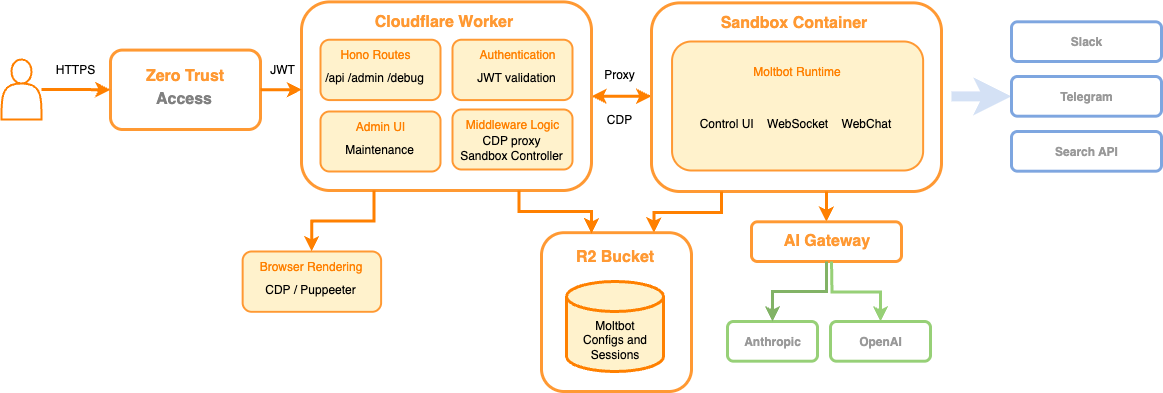
High-level architecture diagram of Moltworker.
Let’s dive in more.
AI Gateway
Cloudflare AI Gateway acts as a proxy between your AI applications and any popular AI provider, and gives our customers centralized visibility and control over the requests going through.
Recently we announced support for Bring Your Own Key (BYOK), where instead of passing your provider secrets in plain text with every request, we centrally manage the secrets for you and can use them with your gateway configuration.
An even better option where you don’t have to manage AI providers’ secrets at all end-to-end is to use Unified Billing. In this case you top up your account with credits and use AI Gateway with any of the supported providers directly, Cloudflare gets charged, and we will deduct credits from your account.
To make Moltbot use AI Gateway, first we create a new gateway instance, then we enable the Anthropic provider for it, then we either add our Claude key or purchase credits to use Unified Billing, and then all we need to do is set the ANTHROPIC_BASE_URL environment variable so Moltbot uses the AI Gateway endpoint. That’s it, no code changes necessary.
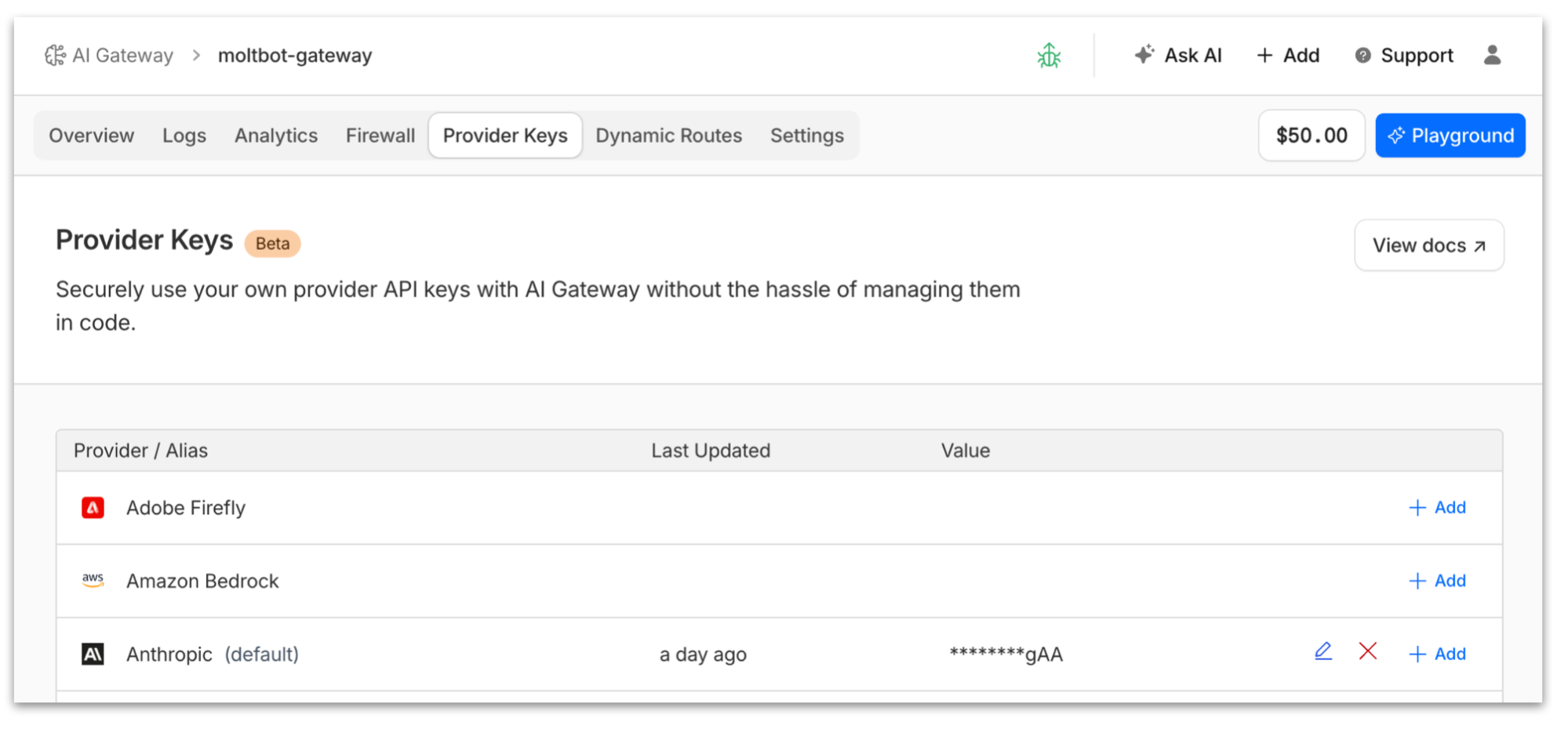
Once Moltbot starts using AI Gateway, you’ll have full visibility on costs and have access to logs and analytics that will help you understand how your AI agent is using the AI providers.

Note that Anthropic is one option; Moltbot supports other AI providers and so does AI Gateway. The advantage of using AI Gateway is that if a better model comes along from any provider, you don’t have to swap keys in your AI Agent configuration and redeploy — you can simply switch the model in your gateway configuration. And more, you specify model or provider fallbacks to handle request failures and ensure reliability.
Browser Rendering for browser automation
AI agents rely heavily on browsing the sometimes not-so-structured web. Moltbot utilizes dedicated Chromium instances to perform actions, navigate the web, fill out forms, take snapshots, and handle tasks that require a web browser. Sure, we can run Chromium on Sandboxes too, but what if we could simplify and use an API instead?
With Cloudflare’s Browser Rendering, you can programmatically control and interact with headless browser instances running at scale in our edge network. We support Puppeteer, Stagehand, Playwright and other popular packages so that developers can onboard with minimal code changes. We even support MCP for AI.
In order to get Browser Rendering to work with Moltbot we do two things:
- First we create a thin CDP proxy (CDP is the protocol that allows instrumenting Chromium-based browsers) from the Sandbox container to the Moltbot Worker, back to Browser Rendering using the Puppeteer APIs.
- Then we inject a Browser Rendering skill into the runtime when the Sandbox starts.

From the Moltbot runtime perspective, it has a local CDP port it can connect to and perform browser tasks.
Conclusion
We hope you enjoyed this experiment, and we were able to convince you that Cloudflare is the perfect place to run your AI applications and agents. We’ve been working relentlessly trying to anticipate the future and release features like the Agents SDK that you can use to build your first agent in minutes, Sandboxes where you can run arbitrary code in an isolated environment without the complications of the lifecycle of a container, and AI Search, Cloudflare’s managed vector-based search service, to name a few.
Moltworker Overview Table
| Feature | Details |
|---|---|
| Product Name | Moltworker |
| Type | Self-Hosted Personal AI Agent |
| Hosting | Fully Self-Hosted (User Controlled Server) |
| Privacy Level | High – Data stays with the user |
| Customization | Fully Customizable AI Workflows |
| Limitations | No Mini Versions / No Usage Restrictions |
| Best For | Developers, AI Enthusiasts, Businesses |
| Key Benefit | Full Control + Security + Scalability |
| Integration | APIs, Automation Tools, Custom Plugins |
| Security | Private Infrastructure Based |
#Moltworker #SelfHostedAI #PersonalAIAgent #AIAssistant #PrivateAI #AIWithoutLimits #OpenSourceAI #AIForDevelopers #AIInnovation #SecureAI #FutureOfAI #AIWorkflow #TechTrends2026 #ArtificialIntelligence #AutomationTools #Carrerbook #Anslation